

In today’s high-pressure work environment, where burnout is epidemic and high level of pressure is omni-present, one of the ways to increase employees and managers health & resilience lies in fostering moments of flow. Flow – the state of deep focus and immersion—has the power to transform employees’ performance, creativity, and wellbeing.
How can organisations create an environment that nurtures these peak moments of productivity and engagement? The answer is simple: by intentionally cultivating the right conditions for flow.
In a flow state, individuals experience both high performance and deep satisfaction, making it a powerful tool for wellbeing & resilience. Flow fosters a sense of accomplishment and control, which in turn strengthens mental and emotional health, helping employees and leaders deal with pressure and setbacks more effectively.
Did you know that, according to research by McKinsey, we are 5 times more productive when we work in flow? Let’s find out how organisations can create more flow-state moments to boost their employees’ health and resilience.
What is Flow
The term “flow” was coined by psychologist Mihaly Csikszentmihalyi in the 1970s. Flow is a state of deep focus and immersion, where individuals are so involved in an activity that they lose track of time, self-consciousness fades, and the task becomes intrinsically rewarding. Flow is often described as the optimal state of consciousness where performance and personal satisfaction are aligned, when we perform our best and feel our best.
In a flow state, people experience both high performance and deep satisfaction, making it a powerful tool for resilience. Flow fosters a sense of accomplishment and control, which in turn strengthens mental and emotional resilience, helping individuals deal with stress and setbacks more effectively.
Csikszentmihalyi identified 8 key characteristics of flow, 8 pre-conditions that lead to flow:
- Clear goal
- Immediate and direct feedback
- Balance between challenges and skills
- Deep concentration and focus
- Lack of awareness of bodily needs
- Altered sense of time
- Feeling of control over the task
- Experience is intrinsically rewarding
The most important point being the challenge/skills ratio. Flow appears near the emotional midpoint between boredom and anxiety, in what scientists call the “flow channel” — the spot where the task is hard enough to make us stretch, and just not hard enough to make us snap.
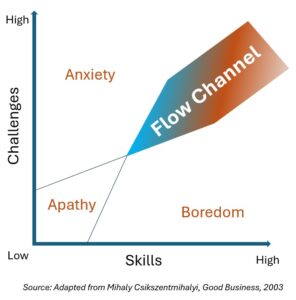
If the task is too easy, apathy and boredom can set in, but if the task is too challenging, anxiety can arise. Both boredom and anxiety are barriers to flow.
To recap, flow occurs when the challenges of a task match our skills, leading to a sense of deep engagement and enjoyment. Flow is not only beneficial for individuals, but also for organisations.
Csikszentmihalyi predicted that the most successful societies and organisations would be those ensuring employees would have as many opportunities as possible to be involved in flow-inducing activities.
How can organisations create more flow?
The greater the flow in an organisation – that is the greater the number of key employees working in that state – the better the teams’ performance.
To stay close to Csikszentmihalyi’s 8 characteristics of flow, here are 6 steps organisations can take to boost flow-state moments within their teams:
-
Set Clear, Achievable Goals
For flow to occur, individuals must understand the purpose of their work and the goals they are aiming to achieve. Leaders should encourage their team members to set clear, measurable objectives that are both challenging and attainable. When individuals know exactly what is expected of them and can track their progress, they are more likely to experience the clarity needed for flow. These goals should align with employees’ skills and interests to ensure a good balance between challenge and ability.
-
Provide Immediate Feedback
Feedback is essential for maintaining flow. It helps individuals understand whether they are progressing in the right direction and allows for real-time adjustments. This can mean regular check-ins, project reviews, or feedback loops that offer constructive input on performance. Leaders should focus on providing both positive and constructive feedback on the spot, ensuring employees know where they stand and how they can improve. When employees feel their efforts are recognized and validated, their engagement and resilience increase.
-
Create Opportunities for Skill Development
To experience flow, individuals must feel that the challenges they face are aligned with their skills. Our attention is most engaged when there’s a very specific relationship between the difficulty of a task and our ability to achieve that task. Organisations should focus on providing opportunities for skills development allowing employees to grow. This could be through training programs, mentoring, or providing challenging projects to encourage employees to stretch their abilities. When employees continuously grow and develop new skills, they become more confident and capable, which in turn enhances their resilience in the face of future challenges.
-
Minimize Distractions
For flow to occur, concentration is key, distraction being the enemy of flow. In many workplaces, distractions such as open floor, excessive meetings, interruptions, or multitasking can prevent individuals from entering flow state. Leaders should promote a culture that values deep work and uninterrupted time for employees to engage fully in their tasks. This might include creating “flow-friendly” environments, such as quiet spaces or scheduling deep work blocks, where employees can dedicate themselves to complex tasks without distractions.
-
Encourage Autonomy
Flow is more likely to happen when employees have a sense of control over their actions. Organisations should encourage employees to take ownership of their work by giving them the autonomy to make decisions and contribute ideas. Leaders who trust their teams and allow them to take risks and solve problems independently create an environment where flow can…flow. This autonomy enhances feelings of competence and accomplishment, crucial for building resilience.
-
Encourage Self-care
While flow can be incredibly rewarding, it is important to remember that overexertion can lead to burnout, illnesses, etc.. Flow should never come at the cost of mental or physical health. Leaders can model healthy work habits, promote breaks, flexible hours, and ensure that employees have the flexibility to disconnect from work when needed. A balanced, restorative approach is essential for sustaining long-term resilience.
Here are a few examples of organisations who made flow a fundamental part of their core philosophy, with a culture that prioritises this kind of deep focus and immersion: Google, Spotify, Patagonia, Toyota, Netflix, Zappos, Trello all empowering teams and individuals to be highly autonomous, which is, as stated above, one of the most critical factors in fostering flow.
Creating flow moments in the workplace is a powerful strategy for enhancing health and resilience of employees and leaders. In today’s complex and demanding work environments, this approach not only improves individual performance but also strengthens organisations. Flow is not just a path to peak performance—it’s a crucial element in building a resilient workforce.
Sources:
The Flow Genome Project, viewed on Feb 18, 2025 at https://www.flowgenomeproject.com/
The Human Performance Magazine by Flow Center, viewed on Feb 24, 2025: https://www.flowcentre.org/post/flow-organisations-what-has-flow-got-to-do-with-the-workplace
Harvard Business Review, Steven Kotler, Create a Work Environment that fosters flow, viewed on Feb 19, 2025 at: https://hbr.org/2014/05/create-a-work-environment-that-fosters-flow
Open AI, ChatGPT, 2025