
It’s been a massive buzz word in the past few years, frequently making the headlines for lots of recent discoveries. Indeed, unlike all other fields of science, neuroscience was only at the embryo level in early 2000.
As I’ve been quite intrigued by the buzz and the neuroscience concept itself, I decided to enrol into a course to dig deeper into the topic, with the idea of leveraging neuroscience to boost employees and organisations’ resilience.
After an intensive course completed just before Christmas and an even more intense final exam last week, I am very proud to announce that, even though I have not received the results yet so not sure whether I got my certificate in Cognitive Neuroscience or not…I feel however legitimate to write about this topic and its connection with the corporate world.
Do you know what cognitive neuroscience is about?
Cognitive neuroscience is a field of study that explores the relationship between the brain and cognitive processes, such as perception, emotions, attention, decision-making, to name a few.
It does study how the nervous system and the brain are involved in conscious (and unconscious!) mental processes, with consciousness being at the core of cognitive neuroscience. Indeed, as mentioned by Nobel Price Eric Kandel: “Consciousness is to the brain what walking is to the legs”, meaning we need legs to walk, and consciousness for the brain to operate.
Let’s find out how relevant it is to leverage such a “newish” science to boost wellbeing and resilience in the corporate world.
In order to do this, let’s look at 4 different processes behind cognitive neuroscience and how we can leverage each of them to boost your employees and leaders’ resilience.
1. Stress & Emotional regulations
The body reacts before the brain. When we face danger, our instinct drives us to fight, flee, (or freeze) even before we consciously feel the emotion of fear. This is the “Peripheralist” Theory, from James-Lange, stating that emotions arise as a result of physiological arousal. When we encounter a stimulus, it creates a bodily response, and then our brain interprets this physical reaction as an emotion.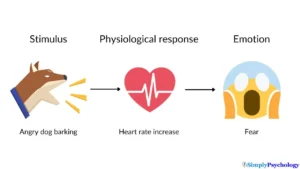
As with many things in science, the corollary exists. If we physically fake a smile, mimicking happiness, we will then feel the emotion of happiness. We can indeed reprogram our unconscious brain, regulate our emotions, with techniques like neurofeedback or biofeedback, as our body knows before us. Same with cardiac coherence techniques, by focusing on our breathe, meaning our body, we can regulate our autonomous nervous system and reduce difficult emotions such as stress, anxiety, fear.
When it comes to emotions regulation, visualisation can be a powerful tool. For example, imagine yourself winning a tennis match or getting a new client. By mentally visualising these scenarios, the part of your brain associated with pleasure and reward (dopamine) is activated, almost as if you had achieved the victory or closed the deal.
So to reduce the level of stress felt by employees, and encourage emotional regulations:
- Offer learning programs including neurofeedback, positive thinking, cardiac coherence, and visualisation to help your employees better regulate their stress level.
2. Our attention is not unlimited
In most organisations, there is high cognitive load, with too many tasks or decisions to complete or take at a time, and these impair decision-making, productivity and resilience. Our attention has its limits, and to be fully focus requires lots of mental and physical energy. Moreover, in our high-speed, and overloaded with information world, we tend to multitask, wrongly believing that by focusing our attention on 4 or 5 tasks at a time will make us more efficient, and more productive. The efficiency of multitasking is merely an illusion, as demonstrated in the graph below: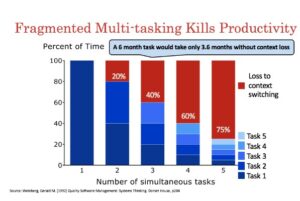
Keeping the above in mind, organisations can help boost their staff’s attention by implementing the following suggestions:
- Encourage monotasking
- Promote frequent and regular breaks to restore cognitive energy and attention.
- Encourage teams to work in flow (article on flow to follow), with full attention and focus on one task, which makes people 40% more efficient, and less exhausted. When we work in a state of flow, we essentially switch off the prefrontal cortex area, which is responsible for managing complex tasks. This allows us, indeed to get less tired, and more performant.
- Reduce complexity, especially in decision-making (easier said than done I know). Our brain needs simplicity to operate at its best
- Encourage mindfulness practices to give our overloaded brain—particularly the prefrontal cortex—a much-needed break. MRI scan of individuals who practice meditation or mindfulness reveal significantly fewer activated neural connections in the pre-frontal cortex. This will help boost attention as the brain wil feel less tired and more able to concentrate and focus.
- And last but not least, promote healthy sleep & rest campaigns as they significantly enhance cognitive attention and improve our ability to maintain focus for extended periods.
3. Perception is not reality
Remember that what you see or what you perceived is not reality. Indeed, 90% of what we see is based on our expectations, predictions, hypothesis, a priori, even on our memories, leaving only 10% to “reality” of what our eyes actually see. We “confabulate” to use a philosophical term, meaning we create fictitious reality to compensate for gaps in our memory. So always remember that what you see or perceive is likely very different from what your colleagues or team members see as your perceptions vary from person to person. Additionally, our perception is inherently influenced by our vision. We spend approximately 20% of our day blinking, which means that 20% of our day is essentially spent with our eyes closed. As the brain dislikes gaps, it feels them with imagination. This highlights that our perception is closely tied to our imagination, functioning like a hallucination shaped by reality.
Look at the below images, which square is darker, A or B, and which Tower of Pisa is more leaning, the right or the left one?
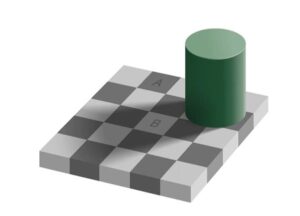

Source: Images used by Professor Olivier Jorand, Cognitive Neurosciences Course, 2024
Indeed, as you can imagine, A and B are the same colour and both Towers are parallel…drop me a line if you want to see the proof…
Now imagine your own organisation, with employees and managers, each having their own “reality” based on their a priori, their predictions. This is a recipe for misunderstanding each other, if not for disaster.
In order to avoid it, and to ensure smooth communication:
- Ensure you adopt a clear communicate, strive for transparency, and regularly check your team’s understanding to align perceptions and prevent misunderstandings.
4. Consciousness vs unconsciousness
The unconscious and consciousness have become, in a very short amount of time, the figureheads of research into brain function and cognitive neuroscience. In nature, the unconscious is the norm, and not the exception. Consider an iceberg: the unconscious represents the massive, submerged portion, while consciousness is merely the visible tip.
In the corporate world, we often overlook this reality, assuming that most of our decisions are made with equanimity, driven by our rational and conscious mind. It’s not true, lots of our decisions are taken unconsciously, often driven by our multiple biases. Research shows that when we are tired, we tend to switch to our System 1, our Fast Thinking system, which is automatic, fast, unconscious, and we are more prone to say “no” than “yes”. So our unconscious mind does have an impact on our decisions, whether we like it or not.
To minimize the risk of making ‘wrong’ decisions influenced by various biases we may have, what organisations can do is:
- Provide staff members with trainings to practice “metacognition”, the ability to reflect on their own thoughts. This skill is key to foster self-awareness and resilience, as it helps individuals monitor and regulate their thoughts, while gaining perspective on their own behaviour, and help take some distance from our own self (often referred to as the helicopter view).
The more we integrate cognitive neuroscience research into our resilience and wellbeing strategies and programs, the better equipped our employees and leaders will be to face the BANI world (Brittle, Anxious, Non-linear, Incomprehensible) we live in.